
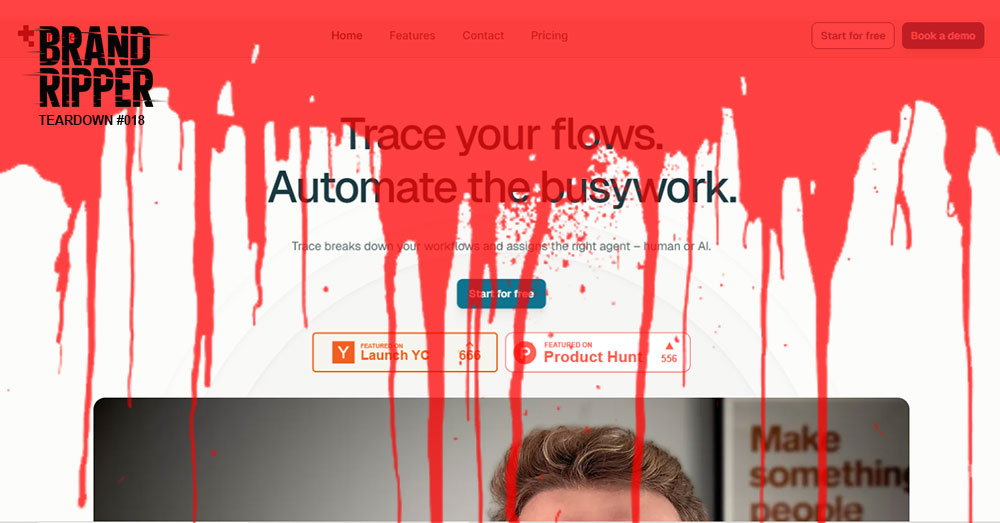

“Automate the busywork without disrupting how you work.” Sleek, seductive, and Silicon Valley-approved. But scratch the surface, and you find autonomy shackled to a UI. Is it liberation—or just relocating control?
Brand Ripper
Trace maps your workflows and routes tasks—great. But is it building autonomy, or building dependence on its own dashboard?
First Impression Killshot
The homepage glows: drag-and-drop workflow mapping, AI or human agents, high-context dashboards, plug-and-play integrations. It’s polished so hard it gleams—and makes you wonder if any friction is allowed.
Surface Polish
- Maps workflows across apps (Slack, Jira, Notion), suggests automation paths
- Templates, AI-human routing, and unified knowledge indexing
- Audit trails, permissions control, multi-agent orchestration
- Context engine that learns team behaviors without disruption
The Reality
- Agencies save time, no doubt.
- But feedback hinges on “looks great” not “drove outcomes.”
- No public case studies or ROI stats—not even 5% more focus.
Fatal Flaws
- Comfort replaces discipline. Users might stop building muscle memory or skill.
- Visibility, not velocity. Nice dashboards—no narrative on impact.
- Context=Control. Leaning on templates discourages strategic divergence.
- Agent black box. Who actually decides which tasks are AI vs human?
Redemption Path
- Outcome mode. Add sections like “Saved 2 hours/day → Focused on X.”
- Explain your thinking. Show why agents were chosen, not just that they were.
- Fail-forward flow. Share user “what went wrong” stories—and trace how the tool helped fix it.
Wrap-Up
Trace hands your team a high-powered dashboard—but without the habits or insight, all you’ve got is a prettier to-do list.
RIPPER VERDICT
Trace is a power cord—not a power-up.
Score: 6/10 — beautiful system, hollow strategy.
See it: https://www.trace.so/
Think your brand can survive the blade?
Submit a target. Choose private (full price) or public (discounted). Free if we feel like it.
Submit a Brand or Hire the Ripper