
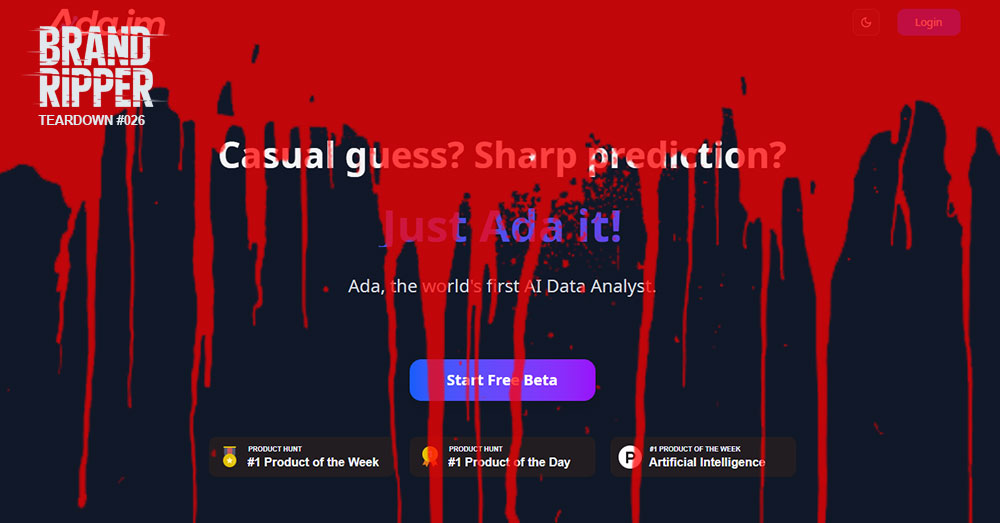

“Up to 83% of support issues resolved.” “Work across messaging, voice, email.” “Proactive, personalized, 24/7.” Big promises. But when your AI starts talking to your customers more than your human team does, do you enhance connection — or hollow it out?
Brand Ripper
Ada promises “AI agents that resolve support at scale” — but is it building trust… or replacing humanity?
First Impression Killshot
The homepage looks like “customer service utopia”: sleek dashboard, enterprise case studies, logos of big brands, claims of resolving most queries without human intervention. You feel like maybe you’ll never have angry “where is my order” emails again.
Surface Polish
Here are the shiney bits:
- Omnichannel AI-powered customer service agents, handling voice, messaging, email.
- “Generative Actions”: AI can do more than reply—it can act across business systems (like booking, order lookup, etc.) without manual scripting.
- Advanced analytics & coaching tools. You can measure, test, refine agents over time.
- Trusted by large companies; enterprise-grade security and policies. GDPR, etc.
The Reality
Here are things that look good, but have friction or missing pieces:
- Resolution numbers are real, but often — from reviews — they’re limited to simpler requests. “What time do you open?”, “Reset my password”, etc. Complex, nuanced support still often needs humans.
- Generative Actions sound powerful, but they require safe guardrails, which Ada provides—but that adds complexity. Also potential risk of errors or mis-action especially when connected to business-critical systems.
- For non-enterprise teams, cost, integration complexity, and customization could be heavy.
- “Personalized” sometimes feels templated — you get a sense of “this is the set-up most customers use”, not bespoke CX.
Fatal Flaws
Here are the biggest risks and flaws I see:
- Empathy deficit: When AI handles most engagement, tone, nuance, emotional understanding can be lost. Errors in tone or misreads risk customer trust.
- Automation over adaptation: If the AI is good, the company might over-automate and stop adapting to customer feedback.
- Opaque action paths: For “Generative Actions”, when AI takes action, you want logs. Mistakes = costly. If not visible, you lose control.
- Overpromise risk: Marketing might push the “83% resolution” metric as safe for all types of tickets. Some cases will always need human touch. If expectations aren’t managed, client dissatisfaction could rise.
Redemption Path
What would make Ada go from “very good” to “exceptional”:
- Transparent logs / audit trails for every action the AI takes. Who approved, what the AI did, what were the downstream effects.
- Emotion & empathy training for the AI: responses that adjust tone based on customer sentiment, not just scripted voice.
- Fail-safes & escalation paths that are obvious and simple to set up: when the AI is unsure, the human steps in.
- Case studies showing complex use cases (not just FAQs) so potential users see what it looks like when Ada supports with nuance.
- Custom voice/tone modules so brands can inject character and not feel “templated.”
Wrap-Up
Ada saves time, scales support, automates a lot — but only truly shines when paired with human oversight, brand voice, empathy. Without those, you risk sterile efficiency.
RIPPER VERDICT
Ada is one of the best enterprise CX tools out there — but its strength is its polish, not its soul.
Score: 7/10 — It gets 80-90% of basic and many medium tasks right. Just risks becoming the “cold helpful robot” if you don’t guard the human.
See it: https://ada.im/home
Think your brand can survive the blade?
Submit a target. Choose private (full price) or public (discounted). Free if we feel like it.
Submit a Brand or Hire the Ripper